
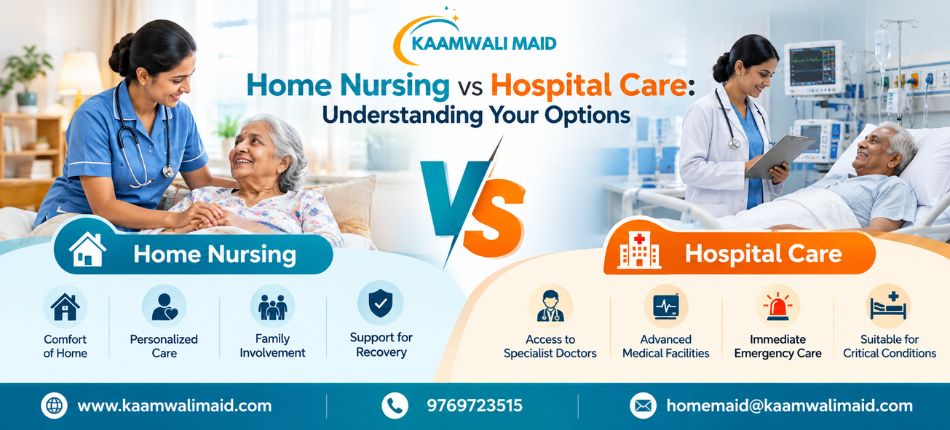
Home Nursing vs Hospital Care: Understanding Your Options – Kaamwali Maid
Both options have their own role. Hospitals are essential when a patient requires continuous medical monitoring, emergency intervention, advanced equipment, or specialist treatment. However, once a doctor considers the patient medically stable, nursing care at home may provide appropriate ongoing support in a familiar and comfortable environment.
For families looking for dependable home-care assistance, Kaamwali Maid helps connect families with suitable home-support solutions based on individual care requirements.
In this guide, we’ll understand the difference between home nursing and hospital care, their key benefits, and important factors to consider when deciding which option may be suitable for your loved one.
What Is Nursing Care at Home?
Nursing care at home provides professional healthcare and nursing support to patients in the comfort of their own homes. It can include health monitoring, medication support as prescribed, wound care, post-surgery assistance, and other nursing services based on the patient’s condition. Home nursing is especially useful for elderly people, recovering patients, and individuals requiring ongoing care. The type of care should always be planned according to medical advice and the patient’s specific needs.
What Is Hospital Care?
Hospital care provides patients with access to doctors, nurses, diagnostic facilities, medical equipment, medications, and emergency services within a clinical setting.
It is particularly important for patients who are medically unstable or require intensive monitoring, emergency treatment, surgery, specialized procedures, or equipment that cannot safely be provided at home.
Hospital care may therefore be necessary during the acute stage of an illness or immediately following certain medical procedures.
Home Nursing vs Hospital Care: Key Differences
| Factor | Nursing Care at Home | Hospital Care |
|---|---|---|
| Environment | Familiar home surroundings | Clinical environment |
| Emergency facilities | Limited compared with hospital | Immediate access |
| Medical equipment | Based on arranged home setup | Wider range available |
| Family involvement | Generally easier | Depends on hospital policies |
| Personal attention | Can be more individualized | Staff may manage several patients |
| Infection exposure | Avoids prolonged stay in a shared clinical environment | Greater exposure to healthcare settings |
| Best suited for | Stable patients needing continued support | Acute, unstable or complex medical conditions |
| Comfort | Familiar and private | Structured medical setting |
Neither option is automatically better. The right choice depends on the patient’s medical needs.
7 Benefits of Nursing Care at Home
1. Recovery in Familiar Surroundings
Being at home allows patients to recover in surroundings they already know. Their own bed, room, belongings, and family members can make the recovery period feel less disruptive.
For elderly patients in particular, familiar routines may make day-to-day care easier to manage.
Home nursing also allows the family to create a quieter environment according to the patient’s comfort and recovery needs.
2. More Personalized Attention
In a hospital, nurses and other healthcare professionals typically care for multiple patients. With dedicated nursing care at home, support can be more closely focused on one patient’s routine and individual requirements.
The caregiver or nurse can become familiar with the patient’s daily schedule, mobility requirements, prescribed care plan, and other practical needs.
This individualized approach can also make it easier for family members to stay informed about everyday care.
3. Greater Family Involvement
Family support can be an important part of recovery.
At home, family members generally have greater opportunities to remain involved in the patient’s daily routine and communicate with the nursing professional.
This can be particularly useful when caring for elderly parents or a family member who requires assistance for an extended period.
At the same time, families should avoid replacing qualified medical care with informal care when professional nursing is required.
4. Helpful for Post-Surgery Recovery
Some patients require continued support after they are discharged following surgery.
Depending on the doctor’s instructions, post-operative nursing care at home may assist with wound care, prescribed medication routines, mobility support, monitoring, and other recovery-related needs.
Instead of travelling frequently for routine assistance, eligible patients may be able to receive some aspects of continuing care at home.
However, any worsening symptoms or complications should be reported promptly to the treating healthcare professional.
5. Suitable for Elderly Patients Requiring Ongoing Support
Senior citizens may need assistance even when hospitalization is not required.
They may experience difficulty with mobility, following care routines, attending appointments, or managing daily activities independently.
Home-based care can help families arrange appropriate support while allowing elderly relatives to remain in their familiar home environment.
It is important, however, to distinguish between a trained nurse, patient-care attendant, caregiver, and domestic helper, because their qualifications and permitted responsibilities are different.
6. May Reduce the Need for an Unnecessary Extended Hospital Stay
Hospitalization is important when clinically necessary, but a medically stable patient may not always need to remain admitted solely for routine ongoing assistance.
If the treating doctor approves discharge and suitable care can safely be arranged at home, home nursing may provide continuity during the recovery period.
This can also allow hospital resources to remain available for patients who require acute medical treatment.
The decision to leave hospital care should always be based on medical advice rather than convenience or cost alone.
7. Flexible Care Based on Patient Requirements
One of the key benefits of nursing care at home is that the level of support can be planned according to the patient’s individual requirements. Some patients may need nursing visits for specific procedures, while others may require longer-duration assistance during recovery. The care plan can consider the patient’s health condition, mobility, medication needs, and family support. This flexibility helps families arrange suitable care without choosing unnecessary services.
When Is Hospital Care the Better Option?
Despite the advantages of home nursing, there are situations where a hospital is clearly the more appropriate setting.
Hospital care may be necessary when a patient experiences severe breathing difficulty, chest pain, uncontrolled bleeding, loss of consciousness, serious injury, sudden neurological symptoms, rapidly worsening illness, or another medical emergency.
It may also be required when the patient needs intensive monitoring, surgery, advanced diagnostic testing, specialist intervention, or hospital-based medical equipment.
In an emergency, families should seek appropriate emergency medical assistance rather than waiting for a home-care professional.
When Can Nursing Care at Home Be Considered?
Home nursing may be considered when a healthcare professional determines that the patient is sufficiently stable to receive appropriate ongoing care outside the hospital.
Depending on individual circumstances, it may be considered for:
Post-Hospital Recovery: Patients who have been discharged but still require professional support.
Post-Surgical Care: Patients requiring appropriate follow-up nursing under medical instructions.
Elderly Care: Seniors requiring health-related assistance alongside everyday support.
Long-Term Care: Patients managing chronic or prolonged conditions who do not require continuous hospitalization.
Mobility-Limited Patients: Individuals who find frequent travel to healthcare facilities difficult and whose required care can safely be provided at home.
The treating doctor should remain involved when the patient’s condition requires ongoing medical supervision.
Home Nurse vs Patient Care Attendant: Know the Difference
This distinction is particularly important when arranging home care.
A qualified nurse is trained to perform nursing tasks within their professional scope, which may include clinical monitoring and prescribed nursing procedures.
A patient care attendant or caregiver generally provides non-clinical support such as assistance with mobility, hygiene, feeding, toileting, positioning, and everyday activities, depending on their training.
A domestic maid should not be presented as a substitute for a qualified nurse.
Before hiring anyone, families should clearly identify whether the patient needs medical nursing care, non-medical attendant care, or household assistance.
What Should You Check Before Hiring Nursing Care at Home?
Choosing the right person is particularly important because the service is being provided to someone who may be vulnerable or dependent on others.
Families should verify the provider’s or professional’s:
- Qualifications and relevant training
- Identity and background documentation
- Experience with similar care requirements
- Scope of services
- Availability and working hours
- Emergency communication process
- Replacement arrangements, where applicable
- Charges and payment terms
Families should also explain the patient’s condition and prescribed care requirements accurately rather than assuming that every home-care professional provides the same services.
How to Prepare Your Home for Nursing Care
A little preparation can make home care easier for both the patient and the professional providing support.
Keep the patient’s room clean, accessible, and appropriately ventilated. Frequently needed medicines and supplies should be organized according to healthcare instructions and kept safely.
If the patient has mobility limitations, reduce unnecessary obstacles around the bed and walking areas. Families should also keep important contact information—such as the treating doctor, nearby hospital, and emergency contacts—readily available.
Any medical equipment used at home should be arranged and operated according to professional guidance.
Is Nursing Care at Home Cheaper Than Hospitalization?
There is no universal answer.
The total cost depends on the patient’s condition, duration and level of nursing required, number of hours of support, equipment, consumables, doctor visits, and other services.
Home care may avoid some costs associated with prolonged hospitalization for medically stable patients, but cost should never be the sole reason for moving a patient out of a hospital.
Safety and the treating doctor’s recommendation should come first.
How Kaamwali Maid Can Help Families
Finding appropriate assistance for a recovering patient or elderly family member can be challenging, particularly for families managing work and household responsibilities at the same time.
Kaamwali Maid helps connect families with home-support services based on their requirements. Before selecting a service, families should clearly specify whether they require a qualified nursing professional, a patient-care attendant, an elderly caregiver, or domestic assistance.
Matching the type of support to the patient’s actual needs is essential for safe and effective home care.
Conclusion
Choosing between home nursing and hospital care is not simply about deciding which option is more convenient.
Hospital care remains essential for emergencies, unstable medical conditions, advanced treatment, and patients requiring continuous clinical monitoring. On the other hand, when a patient is medically stable and the treating doctor considers home-based recovery appropriate, nursing care at home can provide personalized support in familiar surroundings.
Before making the transition, families should understand the patient’s medical requirements, confirm the level of professional care needed, prepare the home appropriately, and maintain communication with the treating healthcare team.
For families looking for Nursing Care at Home, Kaamwali Maid can assist in exploring suitable home-support options based on individual care requirements.
Nursing Care at Home Nursing Care at Home Nursing Care at Home Nursing Care at Home Nursing Care at Home Nursing Care at Home Nursing Care at Home Nursing Care at Home Nursing Care at Home Nursing Care at Home Nursing Care at Home Nursing Care at Home Nursing Care at Home Nursing Care at Home